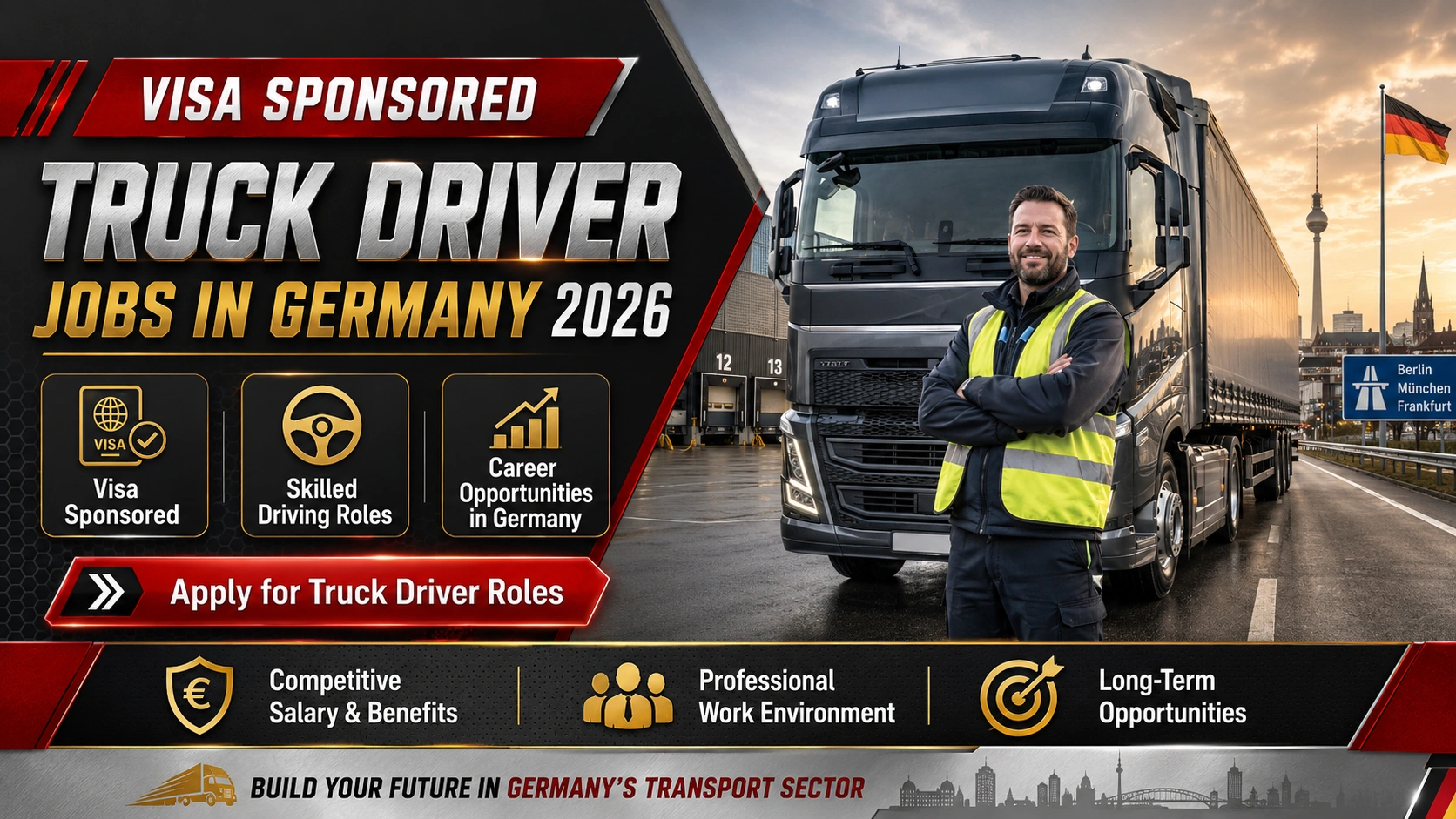
Germany faces a shortage of over 60,000 truck drivers — and that number grows each year as drivers retire and freight volumes increase. The country’s logistics sector, anchored by giants like DHL, DB Schenker, and DACHSER, is actively recruiting foreign professional drivers through Germany’s Skilled Immigration Act, with employers providing full visa sponsorship and often funding the CPC (Code 95) certification for newly hired international drivers.
🚛 What Does a Truck Driver Job Involve?
- Operating Class C (rigid) or CE (articulated/HGV) trucks on national and international routes
- Loading and unloading cargo using tail-lifts, forklifts, and pallet trucks
- Completing digital tachograph records and delivery documentation
- Conducting pre-trip and post-trip vehicle safety inspections
- Following EU driving time and rest regulations (Regulation EC 561/2006)
- Navigating using GPS and logistics management software
- Communicating with dispatchers and delivery recipients
- Maintaining vehicle cleanliness and reporting mechanical faults
🛂 Visa Sponsorship — Germany
Visa Type: German Employment Visa for professional drivers under the Fachkräfteeinwanderungsgesetz (Skilled Immigration Act)
Process:
- Secure job offer from a German logistics employer (DHL, Schenker, etc.)
- Employer obtains Federal Employment Agency (Bundesagentur für Arbeit) approval — standard for driver roles
- Apply for Employment Visa at the German embassy in your home country
- Submit: job contract, driver’s license, CPC/Code 95, police clearance, passport, biometrics
- Travel to Germany; apply for Residence Permit at local Ausländerbehörde within 90 days
Key certificates required:
- Category C/CE driving licence (home country licence may need conversion)
- CPC / Code 95 — many German employers sponsor this training (€2,000–€4,000 cost covered)
⏱️ Timeline: 6–12 weeks
🌍 Eligible Nationalities
Open to all nationalities. Germany actively recruits from:
🇵🇰 Pakistan | 🇮🇳 India | 🇵🇭 Philippines | 🇲🇰 North Macedonia | 🇷🇸 Serbia | 🇧🇦 Bosnia | 🇦🇱 Albania | 🇲🇩 Moldova | 🇺🇦 Ukraine | 🇬🇪 Georgia | 🇰🇿 Kazakhstan | 🇷🇴 Romania | 🇵🇱 Poland | 🇹🇷 Turkey | 🇳🇬 Nigeria | 🇬🇭 Ghana | 🇰🇪 Kenya | and all other nationalities
✅ Germany’s Western Balkans Regulation specifically opens logistics jobs to nationals of Albania, Bosnia, Kosovo, North Macedonia, Montenegro, and Serbia without requiring a skills assessment.
💰 Salary & Benefits
| Component | Details |
|---|---|
| Monthly Salary | €2,430 – €7,000/month (experience-dependent) |
| CPC Training | Employer-sponsored in many cases |
| Public Health Insurance | GKV — mandatory, employer co-pays |
| Pension | DRV contributions from Day 1 |
| Paid Leave | 20–30 days/year |
| PR Pathway | After 5 years of legal residence |
📌 Apply Now
🔗 Apply via Hello Jobs Germany (Driver Specialists)
🔗 Indeed Germany — Truck Driver
🔗 Make It In Germany — Driver Opportunities
🔗 LinkedIn Germany — Truck Driver
✅ Tips
- Hello Jobs is a specialist recruiter for foreign truck drivers in Germany — they manage the entire visa and CPC process for free
- German language is not mandatory for most logistics roles (English + basic German phrases suffice)
- Converting your home country license to a German/EU license is a required step — your employer can assist
- International (non-EU) licenses must be converted within 6 months of receiving your German residence permit
FAQs
1. Is German language required? Basic German helps but is not mandatory for most logistics companies. 2. Does the employer pay for CPC training? Many do — especially large logistics companies actively recruiting abroad. 3. What license category do I need? Category C for rigid trucks; Category CE for articulated (HGV). 4. How long does visa processing take? Typically 6–12 weeks including Federal Employment Agency approval. 5. Can I bring my family? Yes — family reunification is available once your residence permit is issued.
About the Author